
People often use “wasp,” “yellowjacket,” and “hornet” to describe any fast-moving stinging insect. The names overlap in everyday conversation, but the differences matter when a nest is close to a doorway, patio, play area, walkway, or occupied structure.
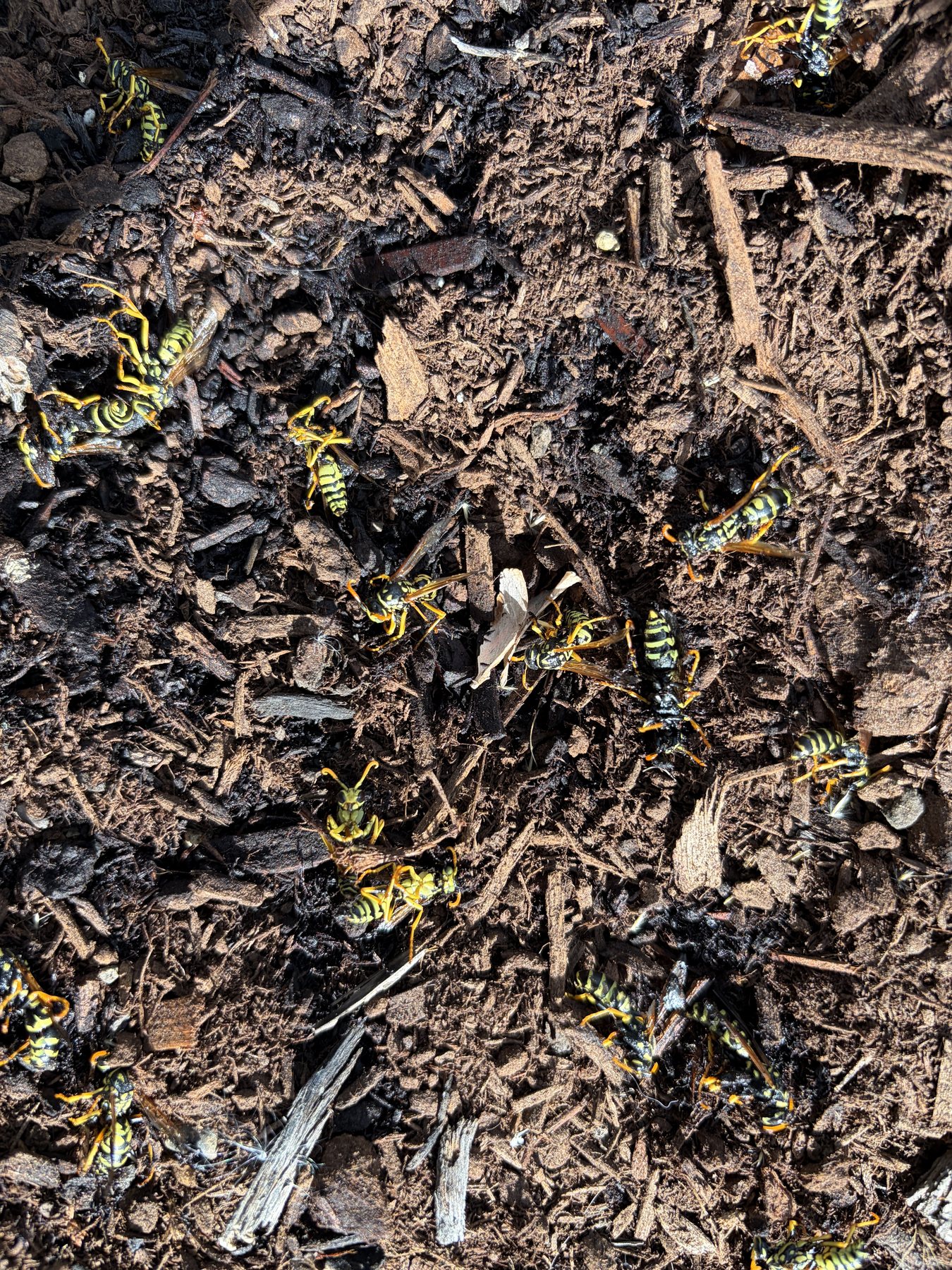
Quick comparison: yellowjacket vs. paper wasp vs. hornet
| Common name | What it often looks like | Common nest clues |
|---|---|---|
| Yellowjacket | Compact, shiny black-and-yellow body with a narrow waist; legs usually held close in flight. | Steady traffic into a ground opening, wall void, landscape timber, or other concealed cavity. |
| Paper wasp | Slender body with a narrow waist and long legs that commonly dangle during flight. | An exposed, umbrella-shaped comb under an eave, railing, light fixture, or other protected surface. |
| Bald-faced hornet | Larger-looking, mostly black body with distinct white markings on the face and abdomen. | An enclosed gray paper nest, often suspended in a tree, shrub, under an eave, or on a structure. |
Yellowjackets: compact bodies and concealed nests
Yellowjackets are social wasps. Several species found in the Pacific Northwest use underground cavities, old rodent burrows, wall voids, attics, hollow logs, or landscape features for nesting. An occasional yellowjacket near flowers or a garbage can does not reveal the nest location. Repeated arrivals and departures from one opening are the stronger clue.
Activity around outdoor food and drinks often becomes more noticeable in late summer and fall. Cover sugary drinks and food, keep garbage closed, and pick up fallen fruit when practical. If a ground nest is disturbed, move away quickly rather than swatting at the insects.
Paper wasps: long legs and open-comb nests
Paper wasps generally look slimmer than yellowjackets. Their long legs can be easy to see hanging below the body in flight. The nest is often the clearest identifier: a single exposed comb with visible cells rather than a fully enclosed paper shell.
These nests commonly appear beneath eaves, deck rails, patio covers, sheds, and other sheltered surfaces. Paper wasps hunt caterpillars and other insects, so a nest that is distant from normal activity may not require treatment. A nest beside a frequently used door or play area is a different situation.
“Hornets” in our area are often bald-faced hornets
The black-and-white bald-faced hornet is not a true hornet despite its common name; it is an aerial-nesting relative of yellowjackets. Its enclosed gray paper nest can grow conspicuous in trees, shrubs, and on structures as the season progresses.
Away from the nest, these insects may simply be hunting other insects. Near the nest, they can defend the colony. Do not shake a branch, strike the nest, spray it from an unsafe position, or stand below it while trying to identify it.
Could it be a honey bee instead?
Honey bees tend to look fuzzier and more golden-brown than the shiny, sharply marked bodies of yellowjackets. A cluster or swarm of bees is also different from wasps repeatedly entering a paper or concealed nest. We do not disturb honey bee colonies. When identification is uncertain, send a safely taken photo so the activity can be evaluated before any treatment decision.
What the season can tell you
Social wasp colonies begin small and grow through the warmer months. That is why a nest can be easy to miss in spring and much more active later in summer. Their nests are generally used for one season rather than occupied again the following year, although new queens may choose another favorable spot nearby.
When professional inspection makes sense
- Insects repeatedly enter a wall, soffit, attic, deck, retaining wall, or ground opening.
- The activity is near a doorway, walkway, patio, play area, pet run, or work area.
- Someone on the property has a known sting allergy or heightened medical risk.
- The nest is above safe reach, concealed, unusually active, or difficult to approach.
- You cannot confidently tell whether the insects are wasps or beneficial bees.
Treatment depends on identification, nest location, height, access, weather, and surrounding conditions. Affordable Pest Pros treats accessible wasp, yellowjacket, and bald-faced hornet nests when the site can be serviced safely. We will be straightforward when special access or another professional is the better fit.
Frequently asked questions
What is the easiest way to tell a paper wasp from a yellowjacket?
Look at body shape, flight, and the nest. Paper wasps are usually slimmer, with long legs that hang below them, and they build exposed open-comb nests. Yellowjackets are more compact and often travel into a concealed cavity or ground opening.
Are bald-faced hornets true hornets?
No. Despite the common name, bald-faced hornets are closely related to yellowjackets. Their black-and-white coloring and enclosed aerial paper nests make them distinctive.
Should I seal a hole that yellowjackets are entering?
Not while the opening is active. Sealing the normal route can encourage the insects to search for another exit, potentially toward the inside of the structure. Identify and address the activity before closing entry points.
Sources and further reading
Identification and seasonal guidance was reviewed against Oregon State University Extension and University of Minnesota Extension resources.